· 5 min read
Why startups shouldn't let a third party own their customer reviews
In short:Owning your reviews means your data is exportable rather than trapped, no platform can quietly remove a real review or force you onto an annual contract to keep your history, and you decide what gets hidden; a startup that hands that control to a third party before it has any negotiating leverage is building trust on terms someone else can change at any time.
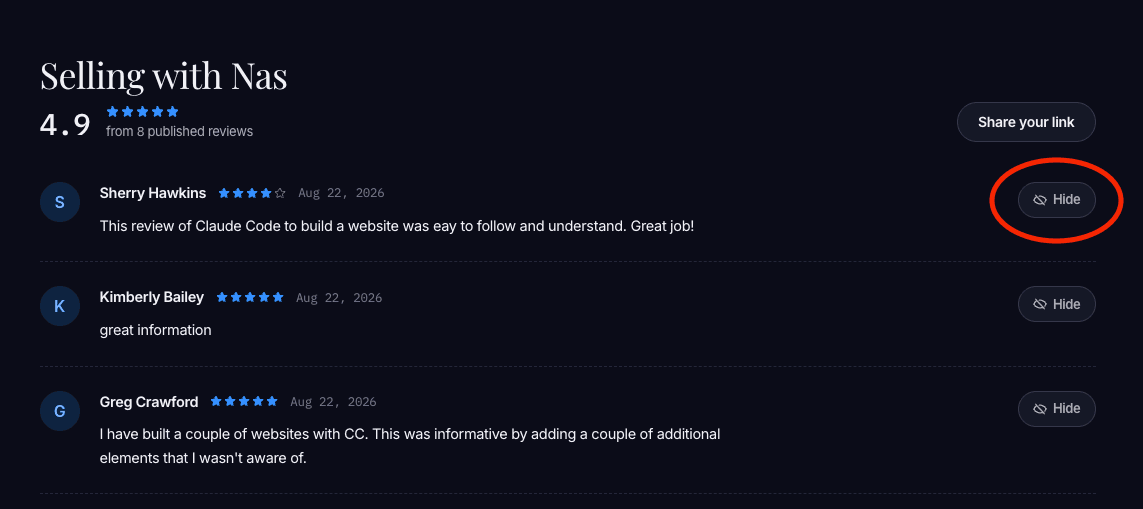
Most startups don't think about who owns their reviews until something goes wrong: a review disappears without explanation, a plan renews at a price nobody agreed to, or a business tries to leave a platform and discovers its own customer feedback doesn't come with it. By then the reviews already exist somewhere else, under someone else's rules, and moving them is far harder than collecting them was in the first place. The screenshot above shows the alternative in practice: a business deciding for itself which review to hide, rather than filing a request and waiting to hear back from a platform that owes it nothing.
What "owning your reviews" actually means
Ownership isn't a slogan here; it's a specific, checkable set of properties a review system either has or doesn't:
- Your data is exportable, not trapped. If a platform doesn't let you get your own reviews out in a usable format, you don't really have them, you're renting access to them.
- No platform lock-in. Leaving shouldn't mean starting your review history over from zero, and staying shouldn't be the only way to avoid that.
- You control what gets hidden. A fake or abusive review is a decision you should be able to make yourself, immediately, not a support ticket you file and wait on.
- A real review can't just disappear. If a customer genuinely wrote it, no one, including the company running the platform, should be able to quietly remove it because it's inconvenient.
- No annual contract holding your history hostage. A business that wants to leave shouldn't have to keep paying for months just to keep its own reviews visible.
- You control how reviews are displayed. The page they live on, the domain they sit under, and the design around them should be yours to decide, not a template you're issued.
Every one of those is a real design decision a review platform makes, whether or not it says so anywhere on its pricing page. Quizzings makes all six in the same direction: toward the business, not the platform.
Real reviews are not removable, by us or by anyone
On Quizzings, a review publishes the moment a customer submits it, with no pre-approval queue standing between the two. Once it exists, the text can never be edited or deleted by anyone, not the business it's about and not Quizzings itself. A business can hide a review from its public page and its widget if it genuinely believes the review is fake or abusive, but hiding is reversible and it isn't deleting, so a review that was hidden by mistake, or hidden by pressure to look better, can always be brought back.
That constraint matters more than it might first appear, because the alternative, a platform that quietly removes reviews it finds inconvenient, is exactly the practice regulators have started cracking down on directly. The FTC's 2024 rule on consumer reviews and testimonials specifically bans review suppression carried out through false legal threats and other pressure tactics, which is a formal acknowledgment that "the platform decided to make it disappear" was common enough to need a rule against it.
Fake and abusive reviews are still yours to deal with
Not deleting real reviews is only half of ownership; the other half is being able to act quickly on the ones that shouldn't be there at all. A review left by someone who was never actually a customer, or one that's abusive rather than critical, needs to come down fast, and that decision belongs to the business the review is about, not to a support queue on someone else's schedule. Our dedicated page on staying in control of your reviews goes through exactly how that works day to day: one click hides a review from public view immediately, and it's still sitting in your dashboard afterward in case you ever want to bring it back.
No yearly contract holding your review history hostage
Quizzings is billed monthly and can be cancelled at any time, which matters for reasons that go beyond simple pricing. A business locked into an annual contract has no real leverage if a platform changes its terms, raises its price, or handles a dispute badly partway through the year, because leaving mid-contract usually means losing access to reviews that took months to collect. Being free to walk away on a month's notice is itself a form of ownership: it means the platform has to keep earning the relationship rather than relying on a signed term to keep you in place regardless of how it behaves.
Your reviews live on your domain, not a third party's
A review collected through Quizzings appears on a page under your own review link and inside a widget you control the layout of, rather than on a listing page that belongs to the platform first and your business second. That distinction shows up in search results too: a review hosted on your own domain contributes to your own site's authority, while a review hosted on a third-party listing page primarily helps that platform's domain rank, with your business as one entry among thousands of others competing for the same attention on the same page.
Why this matters more at the early stage
A large, established brand can absorb a bad experience with a review platform. It has other channels, existing customer trust, and enough leverage to negotiate better terms or simply weather a dispute without it threatening the business. A startup collecting its first reviews doesn't have any of that yet: those first ten or twenty reviews often are the trust signal, sitting on a pricing page or a landing page with almost nothing else there to vouch for the product. Handing that asset to a platform you have no negotiating power with, on terms you didn't write and can't change, means building the one thing you can't afford to lose on someone else's foundation. The content marketing world has a name for this general pattern: building your presence entirely on rented land, where the landlord's incentives and yours only overlap for as long as it's convenient for the landlord.
Starting with a system where the reviews are exportable, the moderation decisions are yours, and the contract can end whenever you want doesn't cost anything extra at the early stage, since signing up and collecting your first reviews takes about as long as reading this article. It just means the trust you build from day one stays built on ground you actually own.
Frequently asked questions
What does it mean to "own" your customer reviews?
It means your review data is exportable rather than trapped on one platform, no company can quietly remove a review a real customer wrote, you decide what gets hidden as fake or abusive, there's no annual contract forcing you to keep paying just to keep your history visible, and the reviews display on your own domain rather than primarily benefiting someone else's listing page.
Can Quizzings delete a review it doesn't like?
No. Once a review is published, its text can never be edited or deleted by anyone, including Quizzings. A business can hide a review it believes is fake or abusive, which removes it from public view, but hiding is reversible and nothing is ever permanently deleted from the dashboard.
Why does it matter that Trustpilot reviews live on Trustpilot's domain?
Because that page belongs to Trustpilot first, with a business's reviews appearing as one listing among many competing for the same visitors. A review on your own domain contributes to your own site's search authority instead, and it can't be reorganized, delisted, or repositioned by a decision made somewhere else.
Is there a real risk in signing an annual review platform contract as a startup?
Yes. An annual, prepaid contract removes your leverage if the platform changes its terms, mishandles a dispute, or simply stops being worth the price partway through the year, because leaving mid-contract typically means losing access to reviews that took months to build. A monthly, cancel-anytime plan keeps that leverage with the business instead.
How does Quizzings handle fake reviews compared to a bigger platform?
A business can hide a review it believes is fake or abusive immediately, from its own dashboard, with no support ticket or waiting period. That review stays saved and reversible rather than being deleted, so the record stays intact even after it's hidden from public view.
Does owning my reviews cost more than using a platform like Trustpilot?
No, generally the reverse. Quizzings starts at $19/mo billed monthly with no annual commitment, while Trustpilot's published Starter plan runs $99/mo per domain under a twelve-month prepaid contract, as covered in our [full Quizzings vs Trustpilot comparison](/blog/quizzings-vs-trustpilot). Ownership and a lower price aren't a trade-off here; they come from the same underlying decision to build the product around the business rather than the platform.